
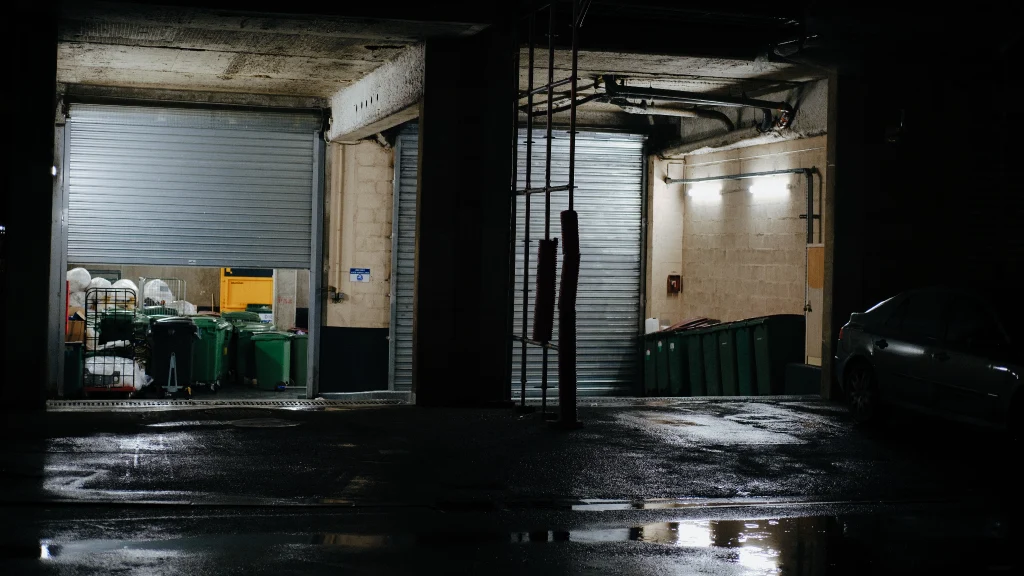
After installing and servicing commercial garage doors across Metro Detroit for over three decades, we get some version of this question almost every week: “What’s this going to cost me?” The honest answer is that commercial garage door cost depends on door type, insulation, cycle rating, and site conditions – but we can give you real numbers to work with, and we can tell you why our climate here plays a bigger role in your quote than most business owners expect.
Michigan doesn’t do mild. We swing from sub-zero, snow-loaded winters to hot, humid summers, sometimes within the same calendar year. That kind of thermal stress is hard on a garage door – and it’s harder still on your energy bill if the door isn’t built to handle it. That’s why insulation isn’t a luxury upsell around here; it’s a line item that directly affects both your upfront price and your long-term operating cost.
Cost by Door Type
Sectional Steel Doors ($1,500 – $6,000)
The workhorse of local auto shops and loading docks. Pricing climbs toward the top of that range when we spec high-R-value polyurethane insulation, which we recommend for nearly every application that sees a Michigan winter. The upfront bump pays for itself in reduced heat loss.
Roll-Up Sheet/Service Doors ($1,000 – $5,000)
Common in storage facilities, warehouses, and retail security applications. These are compact, durable, and cost-effective – a smart pick when insulation isn’t the priority and budget is.
Aluminum and Glass Doors ($4,000 – $12,000)
Increasingly popular for modern Detroit storefronts, restaurants, and fire stations. The look is clean, but the engineering isn’t simple: heavy tempered glass and reinforced framing are required to keep these doors performing through freeze-thaw cycles and summer heat without warping or seal failure.
High-Speed Doors ($5,000 – $25,000+)
Built for high-traffic manufacturing facilities, logistics hubs, and food processing plants. Rapid open/close cycles preserve climate control and keep product moving – critical when conditioned air is expensive to lose every time a truck backs in.
Cost by Component
| Component | Estimated Cost | Details |
|---|---|---|
| Door Kit & Hardware | $900–$5,000 | Pricing at the high end often reflects the insulated, high-cycle steel needed for local manufacturing plants. |
| Labor Burden | $500–$1,500 | Detroit metro rates are competitive with Chicago and Cleveland; rural quotes may be lower, but service response times can be longer. |
| Commercial Opener | $1,300–$3,500+ | Must be rated for Michigan’s cold starts; standard residential openers fail in sub-zero temps. |
| Permits & Inspections | $300–$800 | Detroit Building Department tends to run slower than the suburbs; factor in 2-3 week lead time for approvals. |
We break it down this way because two doors with the same sticker price can have very different values depending on where the money went. A door with a bargain hardware kit and an undersized opener will cost you more in service calls than it saved you upfront.
Metro Detroit Cost Factors
A few local variables move the needle on every quote we write:
- Insulation requirements – Facilities that run climate-controlled interiors, cold storage, or food-grade environments need higher R-values to meet efficiency targets through our winters and summers alike.
- Cycle rating – A door that opens twice a day needs a different spec than one opening 200 times a day. Underspec this and you’ll be replacing springs and rollers well ahead of schedule.
- Site accessibility – Older commercial buildings in cities like Clarkston, Pontiac, and Detroit proper often have tighter headroom, non-standard framing, or structural quirks that add labor time.
- Wind load and snow load – Local code requirements for exposed or elevated installations can require reinforced panels.
- Permitting jurisdiction – Requirements and turnaround times vary by municipality across Oakland, Macomb, and Wayne counties.
If you’re comparing commercial garage doors in Clarkston to options elsewhere in the region, know that jurisdiction-specific permitting and local wind/snow load code can shift a quote more than people expect – it’s worth getting a site-specific number rather than assuming a flat regional price.
What Underspecing Actually Costs You
A few years back, we were called out to a Clarkston auto shop for a door that had failed twice in one winter. The original installer had put in the cheapest sectional door on the market – thin gauge steel, no insulation, a base-grade opener not rated for the shop’s daily cycle count. It held up for about eighteen months before the panels started warping under the freeze-thaw stress and the opener burned out from overuse.
The owner had saved a few hundred dollars upfront. By the time we replaced it – properly specced this time, with polyurethane insulation and a commercial-grade opener rated for the shop’s real traffic – he’d already paid for two service calls, a full winter of high heating bills from a door that wouldn’t seal, and a second install. That’s the math we walk every customer through: the cheapest quote and the cheapest total cost are rarely the same number.
Get a Quote Built on Local Experience
Every quote we put together accounts for how this door will actually perform through a Michigan winter and a Michigan summer – not just how it looks on install day. That’s the difference between a door that holds its seal and its schedule for fifteen years, and one that needs constant attention by year three.
If you’re planning a new install or replacing an aging commercial door anywhere in Metro Detroit, reach out to Pioneer Door for a site-specific quote. We’ve been solving exactly these problems, in exactly this climate, for over 30 years – and we’ll spec the door to your building, not force your building to work around the door!